When someone dies in Tenerife or the Canary Islands
The Canary Islands are Spain, so Spanish law decides the first days. What differs is which British consulate you call, the route home from an island, and what that route does to the cost.

Need to talk to someone?
We answer at any hour, and a call costs nothing. Tell us where your loved one is and we will tell you what happens next.
020 4559 2705At a glance
- What it is
- The steps after a British person dies on any of the Canary Islands, and the route home to the UK.
- Who does it
- A local funeral director on the island registers the death. The travel insurer appoints funeral directors if there is a policy. The consulate in Santa Cruz de Tenerife or Las Palmas advises.
- How long it takes
- Registration and any court involvement come first. Once your loved one is released, a repatriation usually takes 2 to 7 days.
A death in Tenerife, Gran Canaria, Lanzarote or Fuerteventura is a death in Spain, and the Spanish registry, courts and health authorities treat it exactly as they would one in Madrid. The islands keep the same clock as the UK, which helps with calls home. What changes is who you ring at the consulate and how your loved one travels back.
Which British consulate covers your island
| Island | British consulate |
|---|---|
| Tenerife, La Palma, La Gomera, El Hierro | Santa Cruz de Tenerife |
| Gran Canaria, Lanzarote, Fuerteventura | Las Palmas de Gran Canaria |
Either consulate gives priority to a British person who has died. It can explain the island’s procedure, list English-speaking funeral directors and translators, and ask the local authorities for updates on an investigation. It cannot pay for anything, investigate the death or recommend a particular firm. It can also advise on two things families on holiday often need in the first week: how to receive money from relatives in the UK, and how to deal with reporters if the death has made the local or British news.
The first day
Ring the travel insurer before anyone else, if there is a policy. The insurer normally appoints the funeral directors on the island and in the UK, and may cover the repatriation, the translations and any legal fees. A funeral director chosen before that call may not be reimbursed.
The death is then registered at the island’s civil registry, which the local funeral director does for you. Ask for the multilingual certificate, the certificado plurilingüe de defunción, with its English translation, and for spare copies. The certificate gives no cause of death.
If the death was sudden, on a beach, on a hiking trail or in the sea, expect the police and a court to be involved. A judge decides whether there is a post-mortem and when your loved one is released, and that decision sets the whole timetable. Until it comes, no one can give an honest date for a funeral at home.
Who decides what, on an island
Most of the rules on funerals in Spain belong to the regions, and the Canary Islands have their own. The one exception is moving someone out of the country. That belongs to Sanidad Exterior, the Spanish health ministry’s border service, which issues the permission through its SISAEX system wherever in Spain the death happened.
For that permission the funeral director provides the medical certificate of death, the registry certificate, a certificate of embalming or temporary preservation, and a judge’s authorisation if the death was violent. The coffin for an international or an air transfer is a sealed one, and the funeral director signs a declaration that it has been sealed.
The route home, and the cost
From the islands, transport to the UK is usually by air, because there is no road. That is the main reason a quote from Tenerife or Gran Canaria can sit above the estimate for mainland Spain. A cremation on the island, with the ashes carried home on the flight, is the other choice families weigh. It needs the death certificate and the cremation certificate, no permit is needed to bring ashes into the UK, and it closes off an inquest at home.
Once your loved one is home, the registrar where the funeral will be held issues a certificate of no liability to register from the Spanish certificate and its translation. If the cause of death was unknown or unnatural, the coroner for that area must investigate.
The steps that are the same everywhere in Spain are set out in full in what to do when someone dies in Spain. For a figure for your island, our Spain repatriation page starts the quote.
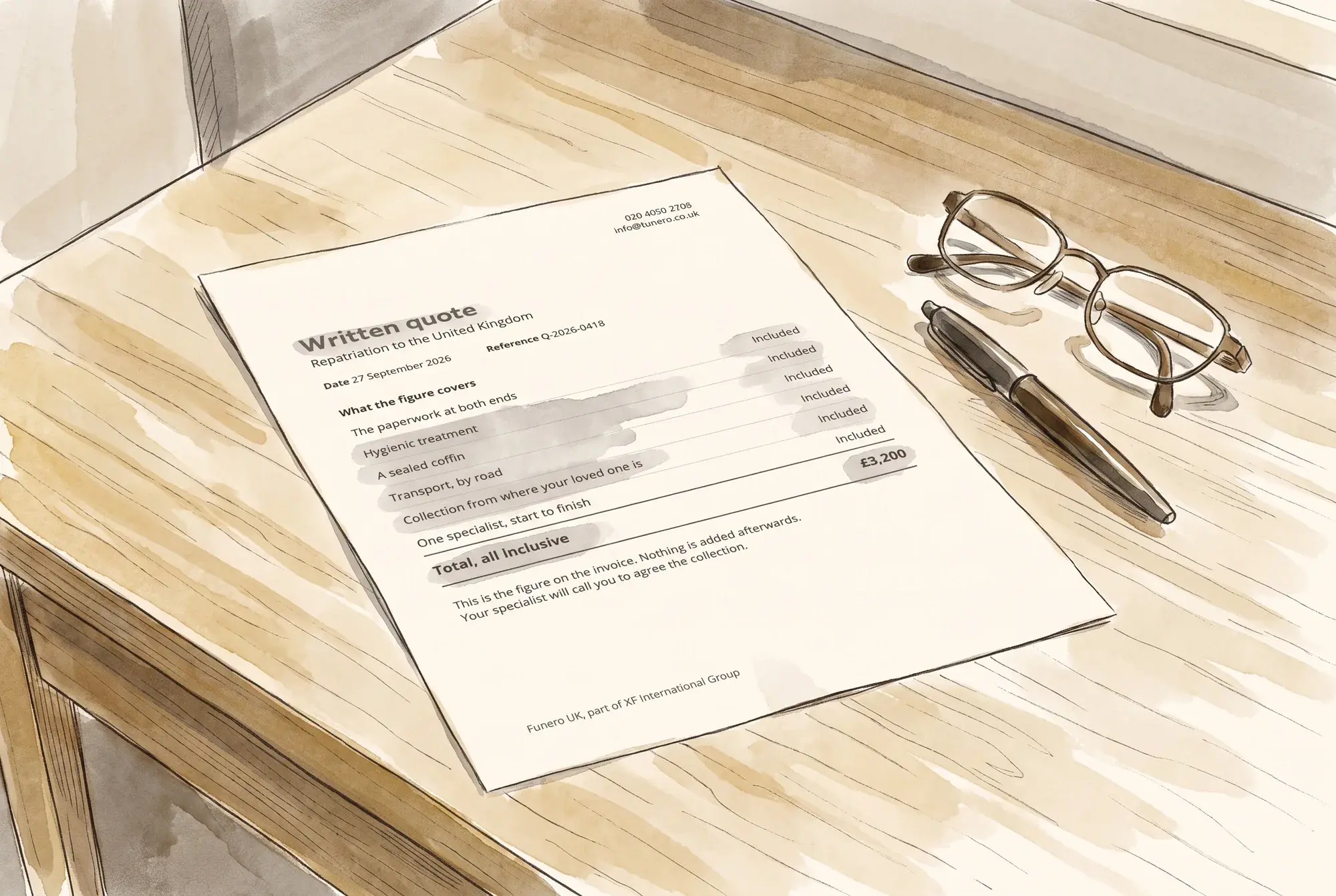
Tell us which island your loved one is on and whether a court is involved, and we send a written quote for that route the same day.
Repatriation to and from Spain- GOV.UK, What to do after a British person dies in Spain
- GOV.UK, British Consulate Santa Cruz de Tenerife
- GOV.UK, British Consulate Las Palmas de Gran Canaria
- GOV.UK, What to do when someone dies abroad
- Ministerio de Sanidad, Traslado internacional de cadáveres
- Ministerio de Sanidad, Guía de consenso sobre sanidad mortuoria, julio 2025

Need to talk to someone?
We answer at any hour, and a call costs nothing. Tell us where your loved one is and we will tell you what happens next.
020 4559 2705


 Nigeria
 Jamaica
 Romania
 Bulgaria
 Slovakia
 France
 Germany
 Hungary